
40,000 plus years of human history
We’re dealing in some big numbers this week. Firstly it was the temperature – 41.7 degrees on the day we arrived in Mildura. It was not very pleasant setting up in that heat, but knowing it was going to be a bit hot we decided to stay somewhere with a pool, and conveniently ended up right next to it.
The good thing about the hot weather here is that it is a dry heat which is far more tolerable than the humidity we get in Brisbane. It’s also short-lived – it took a while to heat up in the morning, was blazing hot all afternoon and evening, but the temperature dropped away once the sun went down. This has happened every day this week (albeit not as hot as that first day) – it’s still getting down to 12-19 degrees overnight which is very pleasant summer sleeping weather.
Mildura is on the banks of the Murray River, which at 2,500 km is not only the longest river in Australia, but also one of the longest in the world. If you’ve been keeping up with your reading, you’ll know that we joined it at Echuca, then followed it to Swan Hill, and have now tracked it here to Mildura. It’s an impressive river too, particularly at the moment when it is full of water. It’s also the lifeblood of the Mildura region which is buzzing at the moment as the grape harvest is in full swing. They’re mostly growing table grapes here, and the sheer scale of it all is pretty amazing.
There’s quite a lot to see and do around here, but top of my list was to visit Mungo National Park in NSW. Often when we choose to visit a national park we have to divide and conquer (thanks to the dog), but in this instance the one we wanted to visit was a 3hr round trip, with much of it on unsealed roads so we really wanted to only go there once. Luckily I managed to find a vet that had doggie day care services so we packed Jett off to play with some doggie mates while we went out there for the day.
I’d heard of the Mungo Man and Woman, but didn’t know too much of the details, and despite the significance of them. The Mungo Woman lived around 40,000 years ago, and her discovery back in the 1960’s pushed out the previously agreed timeline for human habitation in Australia (by a long way). The Mungo Man was discovered a few years later, and he also dates to over 40,000 years ago. In fact, what is now known as Mungo National Park was inhabited by humans for over 2,000 generations – an almost unfathomable length of time.
When we arrived, we first did the foreshore walk which was on the banks of what (until a mere 18,000 years ago) was a huge lake. The kids were quite interested in all the animal tracks around and we tried to identify them all (there’s emu, kangaroo, echidna, foxes, rabbits, beetles, scorpions and much more there).
We then drove out to the Walls of China, or the lunette – the huge and impressive sand hills that were once the northern side of the lake. It is near here that the Mungo Man and Woman were found, and also here that most likely many other significant archaeological artifacts lie. I’ve seen some pretty “old stuff” in my time – pyramids, temples and tombs in Egypt, Roman ruins in Syria and throughout Europe, temples in Asia, churches and cathedrals in the UK, but none of them come anywhere close to the history that is lying within the sand dunes of Mungo.
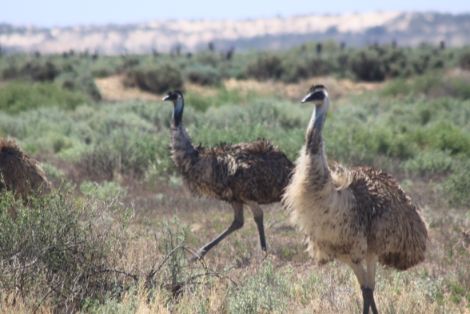
We also saw a mob of emu and a few kangaroos and interesting birds. In its more recent history Mungo was a sheep station, so we looked through the old woolshed and explained to the kids how they would have shorn the many, many sheep on the station, after which we sadly had to start the drive back to Mildura to collect the dog from the vet before they closed.
It was going to be hard to top that, but number two on my list of things to do while we were here was to go to Wentworth to see where the Darling River meets the Murray River. As I mentioned earlier, the Murray River is the longest in Australia. The Darling River comes in at number three at 1,472 km long (number two, the Murrumbidgee River is only 13 km longer, and feeds into the Murray River). Together, they form the Murray-Darling River system – one of the most important river systems in the world.
Another reason I was keen to see it is because both rivers have been in flood recently. Water flows into the Darling from NSW, Qld and South Australia, and because the land is so flat, it takes a long time to travel through the system to join up with the Murray at Wentworth. We’ve been watching for months as the water has made it’s way down the country, and somehow we managed to time it pretty well – the major flooding has passed through, but what’s still flowing down is still very impressive.
The flooding was recent enough that they haven’t really cleaned up yet, so where we stood on the banks looking at the merge point we could see on the trees just how high the water had come up (many metres above our heads). The volume of water that has been through there recently is hard to fathom really. It’s much-needed too as an important natural resource (but I won’t go into the politics of the Murray-Darling River system here…).
We had a bit of a look around Wentworth when we were there, and sadly it looks like it might be one of the many towns that is in decline, whether through Covid or something else who knows, but there were lots of shops closed and not a lot of action going on. We did however see them raise the bridge which was quite good to watch.
Just outside Wentworth was another set of sand hills. They looked very different to the ones at Mungo, but are just as old, or perhaps even older – anywhere from 50,000 to 100,000 years old. In them was an impressive red gum tree estimated to be hundreds of years old, with much of it buried under metres of sand.
We’ve got a couple of days left here in Mildura so we’ll spend them pottering around town, doing some work and schooling, hanging in the pool and getting re-stocked for the next stop. We’re leaving the Murray River now to head south again to the Grampians where we hope to do a few walks, then further south again back to the coast where we’ll tackle the Great Ocean Road and make our way to South Australia.


Previous
Next


1 Comment
Hi Sarah,
Why is everything in Australia so BIG?? Good to know you didn’t mention your Mum and Dad when you said you’d seen some ‘really old stuff’ in your time!
Comments are closed.